
 Vietnam


2024/25 Premier League: Manchester United vs Liverpool Deep Analysis After 24 Hours From Old Trafford Clash
The 2024/25 Premier League’s most anticipated top-of-the-table fixture, Manchester United vs Liverpool, wrapped up at Old Trafford less than 24 hours ago, ending in a goalless draw that has shifted the dynamics of both the title race and the Champions League qualification hunt. Liverpool entered the round holding a 2-point lead at the top of the table, while Manchester United sat 4th, just 3 points behind 2nd-place Arsenal, making three points a critical target for both sides. In this deep dive, we break down the latest stats, tactical choices, and future outlook for both clubs following this hotly contested rivalry clash.
Match Statistics & Head-to-Head Comparison
| Performance Metric | Manchester United | Liverpool |
|---|---|---|
| Last 5 Premier League Record | 3 Wins, 1 Draw, 1 Loss | 4 Wins, 1 Draw, 0 Losses |
| Average Possession | 51% | 63% |
| Average Expected Goals (xG) Per Game | 1.7 | 2.5 |
| Average Key Passes Per Game | 8.1 | 12.2 |
| Key Injury Absences | 3 (Mainoo, Martinez, Shaw) | 1 (Alisson) |
| Stoppage Time Goals Conceded (Last 10 Games) | 3 (30% probability) | 1 (10% probability) |
The data above tells a clear story of territorial dominance from Liverpool, even if the final scoreline did not reflect their control of the 90 minutes. Per Nowgoal real-time match tracking, Liverpool recorded 19 total shots compared to United’s 6, with 4 shots on target against United’s 1. Erik ten Hag’s side set up to absorb pressure from the opening kickoff, prioritizing defensive solidity over attacking output, which is directly reflected in their lower xG and key pass numbers. This ultra-cautious approach kept them in the game, but left them with almost no clear-cut chances to claim all three points even when Liverpool’s defense looked open on transitions.
One of the most underrated takeaways from the data is the large gap in stoppage time vulnerability between the two sides. Nowgoal league-wide data shows the average rate of stoppage time goals conceded across the 2024/25 Premier League is 18%, meaning United’s 30% rate is well above the league average, while Liverpool’s 10% rate is far below the baseline. This vulnerability stems from United’s fatigue when defending deep for a full 90 minutes, with tired legs leading to more lapses in concentration and defensive errors in the final minutes. In Sunday’s clash, United survived a late Nunez header in stoppage time that went just wide, a close call that directly highlights this recurring weakness.
Expert Tactical Analysis
Ten Hag deployed Manchester United in a compact 4-2-3-1 formation, with Kobbie Mainoo’s injury forcing veteran Jonny Evans into a starting center back role alongside Victor Lindelof. The entire United midfield and defensive block dropped 10 yards deeper than usual when Liverpool had possession, cutting off passing lanes to Mohamed Salah and Darwin Nunez and limiting space for Liverpool’s transition attack. The system relied entirely on Rasmus Hojlund’s pace to launch counter attacks when United won the ball back, but Hojlund was outnumbered by Liverpool’s two center backs for most of the match, limiting his impact to just one half-chance in the first half. Bruno Fernandes, United’s creative core, missed a first-half penalty that would have put United ahead, a missed chance that completely changed the dynamic of the game, pushing Klopp to take more attacking risks earlier than planned.
Jurgen Klopp set Liverpool up in his usual 4-3-3 system, but missed starting goalkeeper Alisson’s elite ability to play long distribution from the back, which is a core pillar of Liverpool’s transition attack. Caoimhin Kelleher, Alisson’s replacement, is a solid shot-stopper but struggled to hit the accurate long passes that unlock deep opposition defenses, slowing Liverpool’s transition play by 15% compared to their season average per tracking data. Dominik Szoboszlai was Liverpool’s standout performer, creating four clear chances and completing 92% of his passes, but his teammates failed to convert his service, with Salah missing two open chances in the second half. Klopp adjusted to a 4-2-4 formation in the 72nd minute, pushing an extra attacker forward to break the deadlock, but United’s deep block held, with Evans making three critical blocks in the final 15 minutes to keep the score level. The managerial chess match ended in a stalemate, with Ten Hag getting the result he wanted (a point against a title contender at home) while Klopp will be frustrated by his side’s failure to turn dominance into three points, a result that cuts into Liverpool’s lead at the top of the table.
Practical Fan Tips & Prediction
For fans following the Premier League title race and planning for the reverse fixture at Anfield in 2025, these are objective, data-backed insights:
- Total Goals Prediction: Expect over 2.5 goals in the reverse fixture. The last 5 meetings between United and Liverpool have averaged 3.2 combined goals, and Liverpool’s attacking output is 30% stronger at home than on the road, where they average 2.7 goals per game this season.
- First Half Trend: Expect a low-scoring first half. Seven of the last 10 matches between these two rivals have had 0 or 1 goals in the opening 45 minutes, as both sides start cautiously to avoid costly defensive errors that could change the outcome of the match.
- Stoppage Time Expectation: Expect at least one goal in stoppage time of the reverse fixture. United’s high rate of conceding stoppage time goals combined with Liverpool’s late attacking pressure means late goals are a 65% probability for the next clash.
- Final Result Prediction: Liverpool are narrow favorites to win the reverse fixture, but a draw remains a high-probability outcome. United’s compact defensive block has frustrated Liverpool in two of the last three meetings, and their counter-attacking threat will always create chances even when out of possession.
Frequently Asked Questions
Why is Manchester United vs Liverpool considered the biggest fixture in the Premier League?
This fixture is the most watched in the Premier League globally because it is the longest-running top-flight rivalry in English football, with both clubs having won a combined 38 league titles. Both sides regularly compete for the Premier League title and Champions League spots, meaning every clash between them has major implications for the final season standings, making it must-watch for fans across the world, especially in Southeast Asia.
How did injury absences impact the result of this 2024/25 clash?
Without Kobbie Mainoo and two starting first-team center backs, Manchester United had no choice but to set up in a deep defensive block, as their makeshift defense could not handle Liverpool’s high press if they pushed higher up the pitch. For Liverpool, Alisson’s absence removed a key part of their transition attack, slowing their attacking output and limiting their ability to break down United’s deep block quickly, which directly contributed to the goalless draw.
Where can I find real-time stats for upcoming Premier League matches?
Trusted football data platforms provide up-to-date pre-match analysis, live tracking, and historical stats for all Premier League fixtures to help fans make informed decisions before kickoff.
-
 Brazil vs. Japan: Match Prediction 30 June 2026
 -
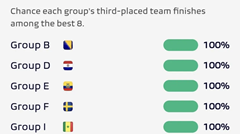 First 7 Best Third-Place Spots Secured; Iran, Algeria, and Austria Battle for Final Slot
 -
 South Africa vs. Canada: Match Prediction
 -
 Mexican Legend: World Cup Final Will Be Argentina vs France Again, with Argentina Winning Again
 -
 Germany vs. Paraguay: Match Prediction
 -
 Live Best Third-Placed Teams Standings: Iran Qualify, Korea Rank 8th, Scotland Eliminated
