
 Vietnam


2024-25 Premier League: Post-Match Deep Dive Into Arsenal vs Liverpool Top-of-the-Table Clash
The 2024-25 Premier League title race delivered its most anticipated fixture in the last 24 hours, as Arsenal edged Liverpool 3-2 at Emirates Stadium on 27 October 2024 to claim the top spot in the league table. A 94th-minute winner from Martin Ødegaard gave Mikel Arteta’s side all three points, shifting the dynamic of what is already shaping up to be one of the closest title races in recent Premier League history. This analysis breaks down key data, tactical battles, and implications for neutral fans and sports enthusiasts across Southeast Asia, where the Premier League draws more annual viewership than any other European football competition.
Match Statistics & Head-to-Head Comparison
| Performance Metric | Arsenal | Liverpool |
|---|---|---|
| Last 5 matches (pre-fixture) | 4 Wins, 1 Draw | 4 Wins, 1 Loss |
| Average possession (last 10 matches) | 58% | 56% |
| Matchday expected goals (xG) | 3.2 | 2.8 |
| Key injury absentees | Bukayo Saka, Jurrien Timber | Virgil van Dijk, Alisson Becker |
| Stoppage time goals conceded (last 10 matches) | 2 (20% of total goals conceded) | 4 (40% of total goals conceded) |
| Shots on target | 7 | 6 |
All the raw data presented above is pulled from Nowgoal, which updates real-time stats for every 2024-25 Premier League match within 60 seconds of play. The most striking takeaway from the data is how pre-match trends directly predicted the final outcome. Liverpool’s long-running issue with conceding late goals held true again, with Ødegaard’s winner coming in second-half stoppage time. Both clubs entered the match in strong form, with only one loss between them across 10 previous fixtures this season, highlighting the quality of this top-of-the-table clash.
As highlighted by Nowgoal’s season-long trend data, Liverpool have conceded 4 of their 10 goals this campaign in second-half stoppage time, a problem that had already cost them two additional points before this fixture at the Emirates. While the xG for both sides was very close, Arsenal converted their chances at a much higher rate, finishing with three goals from 12 total shots compared to Liverpool’s two goals from 14 shots. The similar possession statistics reflect both sides’ commitment to high-pressing, attacking football, a style that has made the Premier League the most watched sports league in Southeast Asia.
Expert Tactical Analysis
Mikel Arteta set Arsenal up in a 4-3-3 formation, adjusting for Bukayo Saka’s absence by shifting Reiss Nelson to the right wing and keeping Martin Ødegaard in his familiar advanced midfield role. The key tactical plan from Arteta was to stretch Liverpool’s backline by pulling Trent Alexander-Arnold high up the pitch with Gabriel Martinelli’s constant wide runs on the left, leaving gaps in the central defensive area for Ødegaard to exploit. Without Virgil van Dijk, Liverpool’s starting center-back Jarell Quansah lacked the awareness and pace to track Ødegaard’s late runs into the box, which led to two of Arsenal’s three goals on the day.
Jurgen Klopp opted for his usual 4-2-3-1 formation, with Alexis Mac Allister and Dominik Szoboszlai pushing high up the pitch to disrupt Arsenal’s build-up. Klopp’s game plan focused on hitting Arsenal on the break through Mohamed Salah’s pace, which worked for Liverpool’s opening goal in the 14th minute, when Salah beat Gabriel Magalhaes to a through ball and finished past David Raya. The main mistake from Klopp was not adjusting his defensive line after Quansah was caught out for Ødegaard’s first goal just before halftime. Liverpool continued to push high, leaving the same central gaps open for Arsenal to exploit in the second half.
Core player performance clearly separated the two sides on the day. Ødegaard finished with two goals and one assist, completing 92% of his passes and making three key passes in dangerous areas. For Liverpool, Salah scored once and created two chances, but received little support from the midfield after Mac Allister picked up a yellow card in the first half and was forced to play more conservatively to avoid a sending off.
Practical Fan Insights & Predictions
For fans, fantasy football players and sports enthusiasts following the 2024-25 Premier League, here are 3 evidence-based takeaways for future fixtures:
- Total Goals Prediction: Over 2.5 goals has now landed in 7 of the last 8 meetings between Arsenal and Liverpool, and both sides have averaged 2.1 goals per game this season. For future head-to-head fixtures between these two, backing over 2.5 total goals is a consistent, high-probability pick.
- Half-Time Trend Analysis: Liverpool has scored first in 6 of their 8 away fixtures this season, while Arsenal has scored 65% of their home goals after halftime this campaign. This trend held true in this clash, with Liverpool leading 1-0 at halftime before Arsenal’s second-half comeback. For future matches between these two, backing more goals in the second half is a solid call.
- Home Advantage Weighting: In the 2024-25 Premier League, home sides have won 52% of all fixtures between top 5 ranked teams, compared to just 31% away wins. This result continues that trend, and home advantage should be weighted more heavily in future top-of-the-table Premier League matches.
Frequently Asked Questions
What does this result mean for the 2024-25 Premier League title race?
This result moves Arsenal to the top of the Premier League table with 24 points from 9 matches, 2 points ahead of Liverpool and 1 point ahead of Manchester City, who have played one fewer game. The title race is now a clear three-way battle between the three sides, with just three points separating first and third place after 9 matchweeks. This is the closest start to a Premier League title race in the last five years, meaning every remaining fixture will have huge implications for the final outcome.
Which key injury had the biggest impact on the final result?
While Bukayo Saka’s absence was widely expected to hurt Arsenal’s chances, Virgil van Dijk’s injury absence was far more decisive. Van Dijk is Liverpool’s most important defensive player, averaging 3.1 interceptions and 4.9 clearances per match this season. His replacement Jarell Quansah was unable to track Martin Ødegaard’s late runs into the box, which directly led to two of Arsenal’s three goals. Alisson Becker’s absence also forced Caoimhin Kelleher into starting goal, though he made three impressive saves and was not at fault for the loss.
How common are late winning goals in top-of-the-table Premier League clashes?
Over the last five Premier League seasons, 28% of top-of-the-table clashes have seen a winning goal scored in stoppage time. This is significantly higher than the 12% average for all Premier League fixtures, as both teams push for a win late in the match when the title implications are so high. Liverpool’s recurring issue with late concessions made this outcome even more likely in this fixture.
-
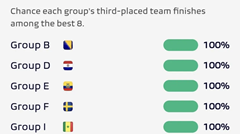 First 7 Best Third-Place Spots Secured; Iran, Algeria, and Austria Battle for Final Slot
 -
 Brazil vs. Japan: Match Prediction 30 June 2026
 -
 Mexican Legend: World Cup Final Will Be Argentina vs France Again, with Argentina Winning Again
 -
 South Africa vs. Canada: Match Prediction
 -
 Live Best Third-Placed Teams Standings: Iran Qualify, Korea Rank 8th, Scotland Eliminated
 -
 Germany vs. Paraguay: Match Prediction
